Planning
How Long Land Clearing Takes
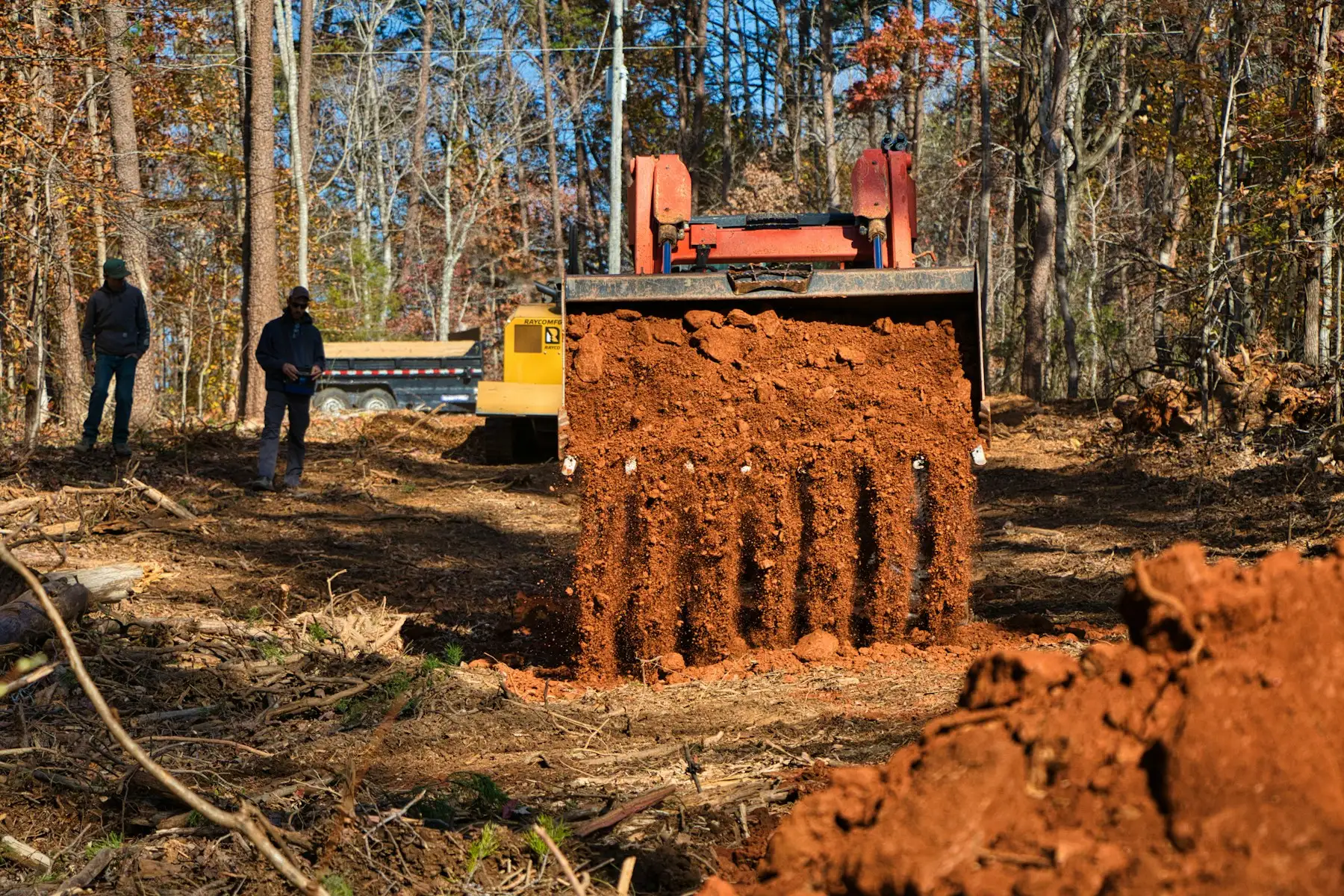
People ask how long clearing takes because they are trying to plan something else around it: a builder, a closing, a fence crew, a planting window.
So the useful answer is not just machine hours. It is machine hours plus everything that has to happen before a machine can start.
Machine time, per acre
Assuming reasonable access and one properly sized machine:
| Method and density | Time per acre |
|---|---|
| Bush hogging light brush and grass | 1 – 3 hours |
| Mulching light to moderate growth | 4 – 8 hours |
| Mulching dense woods | 1 – 2 days |
| Mulching mature mixed hardwood | 2 – 3 days |
| Full clearing, stumps grubbed, debris hauled | 2 – 4 days |
A tidy one-acre mulching job is often a single day on site. A one-acre full clear with grubbing and haul-off is usually most of a week once trucking is counted.
Larger tracts get faster per acre, not slower. Setup and mobilization are close to fixed, so a ten-acre mulching job rarely takes ten times a one-acre job.
What makes machine time move
Trunk diameter, more than tree count. A mulching head is efficient up to roughly eight to ten inches. Past twelve to fourteen, progress slows sharply and the job may want a different machine entirely. A dense stand of pine saplings can clear faster than a sparse stand of mature oak.
Where debris goes. Mulching in place has no haul cycle. The moment material leaves the property, the schedule is partly a trucking schedule — load, drive, tip, return — and that is often the longest part of a full clear.
Stumps. Leaving them is fast. Grubbing them out is a separate operation with its own pace, and on hardwood with a wide root flare it is slow.
Access. If a lowboy cannot reach the work area, someone builds a route first. That is real time before any clearing.
Weather. Not the rain itself, the days after. Georgia red clay holds water, and a saturated site either waits or gets torn up. In a wet stretch this is the single biggest cause of slipped dates.
The part that actually makes projects late
Machine time is usually the small number. These are the ones that move a start date by weeks.
Utility locates. Georgia 811 typically takes a few business days. Free, legally required, non-negotiable. Call it the day you decide to clear, not the day before the crew arrives.
Permits. If you are disturbing an acre or more, a Land Disturbance Activity permit applies, and review takes as long as your county takes. This is measured in weeks, not days. See the permit guide.
Wetland delineation. If there is any chance of jurisdictional wetlands, a delineation happens before clearing, and that is a scheduled site visit plus a report.
Burn windows. If burning is the disposal plan, you need conditions to cooperate, and a permit can be suspended on the day. Plans that depend on burning are the least predictable plans.
Equipment availability. Spring and early summer are busy. Booking in February for March is very different from calling in April wanting next week.
Realistic end-to-end timelines
Half-acre residential lot, mulched, no permit: Call to finished, roughly one to two weeks. Locates are the long pole. Machine time is a day.
Two acres, full clear with haul-off, no permit: Two to three weeks. Three to five days on site once started.
Five acres, permit required: Four to eight weeks, dominated by permit review. Machine time might be a week of that.
Ten-plus acres, permitted, near water: Two to four months, sometimes more. Delineation and permitting run the schedule; clearing is the short part at the end.
The pattern is consistent: the bigger the job, the more the timeline is paperwork and the less it is machines.
Season matters here
Winter clearing in the CSRA has real advantages — bare deciduous growth means better visibility, no snakes, no ticks, no heat. The tradeoff is wet clay. Summer gives you firm ground and long days, and costs you working conditions and dense foliage. There is more on this in the seasonal guide.
How to not be the reason it slips
- Call Georgia 811 early. It costs nothing and it is frequently the thing everyone waits on.
- Ask about permits before you schedule. An acre is the threshold that changes the timeline.
- Decide about stumps up front. Grind or grub is a different job, not a detail.
- Do not build a plan around burning.
- Book ahead in spring.
- Leave slack after rain. A site that needs two dry days needs two dry days.
Tell us the address, the acreage, and when you need the ground ready. If the date is not realistic, you will hear that on the call rather than three weeks in.